people standing inside city building

An Analysis of Revised Minimum Capital Requirements for Capital Market Operators (Sec Circular No. 26-1) – Insights for Market Participants

1. INTRODUCTION

The Securities and Exchange Commission (SEC) of Nigeria has issued Circular No. 26-1,[1] revising the Minimum Capital (MC) requirements for all regulated capital market entities. Issued on January 16, 2026, it takes effect immediately, with a compliance deadline of 30th June, 2027.[2] This represents the most significant recapitalisation exercise since 2015.[3] The review is driven by the need to strengthen market resilience, enhance investor protection, and align capital adequacy with evolving risk profiles of market operators.[4]

This directly advances SEC’s statutory objective under Section 3(3)(a) of the Investments and Securities Act (ISA) 2025 to “contribute to the reduction of systemic risk and promote financial stability.”[5] The circular explicitly states these statutory thresholds “align capital adequacy with the evolving risk profile of capital market operations,” ensuring intermediaries possess “sufficient financial capacity to discharge obligations sustainably even under stress.”

In terms of inter-regulatory alignment, the SEC recapitalisation move seems to also mirror CBN’s banking recapitalisation[6] logic that stronger balance sheets equals lower systemic risk. This reflects an effort to transform fragile operators into resilience pillars that maintain market continuity, investor confidence, and foreign inflows. The circular ultimately shows a step beyond regulatory optics toward quantifiable loss-absorption capacity as a means to achieving “enhanced financial soundness”

This piece intends to offer an exposition of the circular to the arrays of operators, practitioners, and clients, to which the new development pertains, while providing insights on compliance and other oversight needs.

2. KEY REVISIONS: A SECTORAL ANALYSIS

The revisions are profound, with increments ranging from 200% to over 3,400% across categories of regulated market operators. It has a wide scope of application, covering:[7]

  1. Core and non-core capital market operators;
  2. Market infrastructure institutions;
  3. Capital market consultants;
  4. Financial technology (FinTech) operators;
  5. Virtual Asset Service Providers (VASPs); and
  6. Commodity market intermediaries.

The recapitalisation update affects operators across different tiers of the market with varying degrees of attention. Securities sub-brokers, consultants, and commodity brokers; fund and portfolio managers; issuing houses, registrars, rating agencies, and trustees; market infrastructure providers; as well as FinTech and virtual asset service providers are now subject to revised capital requirements in order to continue participating in the market. The table below highlights the key changes to the minimum capital thresholds for these operators as outlined in the Circular.

Table 1: Recapitalisation for Operators[8]


Regulated Entities

2015 MC (₦)

Revised MC (₦)

A)   CORE REGULATED FUNCTIONS

– Brokerage Services


Broker (client execution only)

200.00 million

600 million

Dealer (proprietary trading only)

100.00 million

1.00 billion

Broker-Dealer

  • client execution, proprietary trading, margin/securities lending and advisory services.

300.00 million

2.00 billion

Sub-Broker (Digital)

10.00 million

100.00 million

Sub-Broker (Corporate)

10.00 million

50.00 million

Sub-Broker (Individual)

2.00 million

10.00 million

Inter-Dealer Broker

50.00 million

2.00 billion

Fund/Portfolio Management Services


Tier 1 – Portfolio Managers (Full Scope)

  • Management of Collective Investment Schemes (CIS) and Alternative Investment Funds (Private Equity, Venture Capital, Infrastructure Funds etc.) above ₦20.00 billion Net Asset Value (NAV).
  • Discretionary and Non-Discretionary Private Portfolio Management Services above ₦20.00 billion Assets under Management (AuM).
  • Exposure to foreign instruments up to 40% of the NAV. Note – Any Fund and Portfolio Manager with NAV/AuM of more than ₦100.00 billion should have a minimum of 10% of the NAV/AuM as capital.

150.00 million

5.00 billion

Tier 2 – Fund/Portfolio Managers (Limited Scope)

  • Management of CIS with limited pooled fund creation of not more than 10 times the required capital (₦20.00 billion) on Net Asset Value (NAV).
  • Discretionary and Non-Discretionary Private Portfolio Management Services of not more than ₦20.00 billion.
  • Exposure to foreign instruments of not more than 20% of the NAV.

150.00 million

2.00 billion

Tier 3 – Alternative Investment Fund Managers: Private Equity Fund Manager

150.00 million

500.00 million

Tier 3 – Alternative Investment Fund Managers: Venture Capital Fund Manager

20.00 million

200.00 million

B) NON-CORE REGULATED FUNCTIONS


Issuing House: Tier 1 – Issuing House

  • Non-Interest Finance services
  • Advisory & Arrangement services
  • No underwriting

200.00 million

2.00 billion

Issuing House: Tier 2 – Issuing House with Underwriting

  • Offers a ‘one-stop-shop’ for issuers.
  • Provide underwriting services.
  • Renders advisory and product development services.

200.00 million

7.00 billion

Rating Agency

150.00 million

500 million

Registrar

150.00 million

2.5 billion

Trustees

300.00 million

2.00 billion

Underwriters

200.00 million

5.00 billion

Investment Adviser (Corporate)

5.00 million

50.00 million

Investment Adviser (Individual)

2.00 million

10.00 million

C) MARKET INFRASTRUCTURE


Central Counter Party (CCP)

5.00 billion

10.00 billion

Clearing and Settlement Company (CSC)

200.00 million

5.00 billion

Composite Securities Exchange

  • Trading and Listing of all types of securities.

500.00 million

10.00 billion

Non-Composite Securities Exchange

  • Focus on a single type of security, commodity or financial product.

500.00 million

5.00 billion

Trade Repository

100.00 million

150.00 million

D) CONSULTANTS


Capital Market Consultant (Corporate)

5.00 million

25.00 million

Capital Market Consultant (Individual)

0.5 million

2.00 million

Capital Market Consultant (Partnership)

2.00 million

10.00 million

E) FINTECHS


Robo Adviser

10.00 million

100.00 million

Crowd Funding Intermediary

100.00 million

200.00 million

F) VIRTUAL ASSET SERVICE PROVIDERS


Ancillary Virtual Assets Service Providers (AVASPs)

N/A

300.00 million

Digital Assets Offering Platform (DAOP)

500.00 million

1.00 billion

Digital Assets Intermediary (DAI)

N/A

500.00 million

Digital Assets Platform Operator (DAPO) (including Token issuers)

N/A

500.00 million

Real-world Assets Tokenization and Offering Platform (RATOP)

N/A

1.00 billion

Digital Assets Exchange (DAX)

500.00 million

2.00 billion

Digital Assets Custodian

500.00 million

2.00 billion

G) COMMODITY MARKET INTERMEDIARIES


Collateral Management Company (CMC): Tier 1 – Local/ Regional Operations

50.00 million

200.00 million

Collateral Management Company (CMC): Tier 2 – National/International reach

50.00 million

500.00 million

Commodities Broker/Dealer

10.00 million

50.00 million

Commodities Broker

7.00 million

30.00 million

Commodities Dealer

3.00 million

20.00 million

Warehousing Operators

50.00 million

500.00 million

H) OTHER ENTITIES


Custodian of Securities (Bank)

200.00 million

As prescribed by the CBN

Non-Bank Custodian

50.00 billion + 0.1% of AUC

Dealing Member Banks

200.00 million

As prescribed by the CBN

Nominee Company

0.001 million

5 million

Receiving Banker (Banker to an Issue)

200.00 million

N/A

3. IMPLICATIONS FOR MARKET PARTICIPANTS

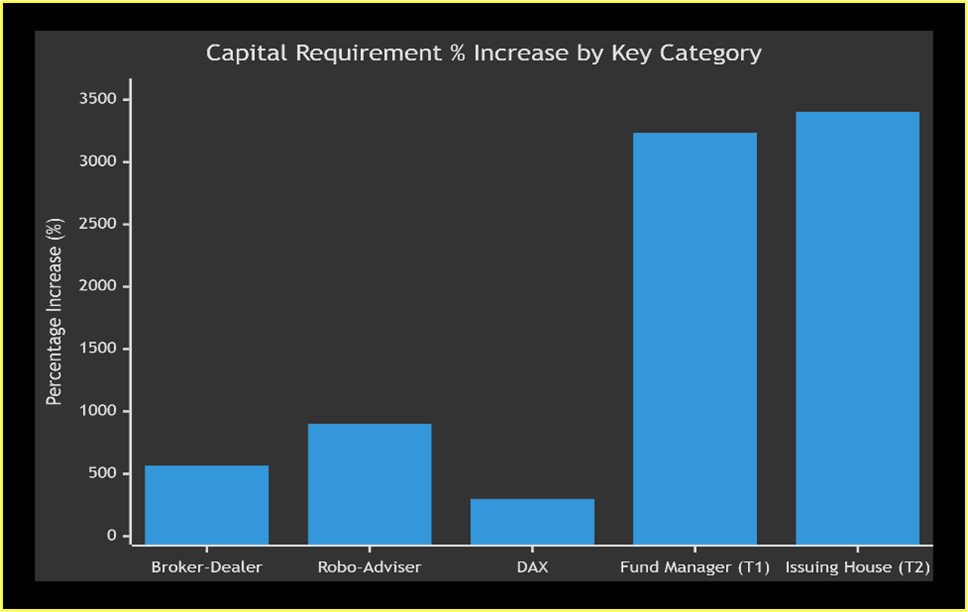
The gap between the previous and revised capital bases is significant.. While the policy rationale is clear (strength and value of Nigeria’s economy), the burden and shock it deals on the market will likely spur structural adjustments. Participation in some operational domains may shrink. The selective review of broker-dealers, fund managers, issuing houses, custodians, digital asset exchanges, and robo-advisers below show that the revised thresholds will drive spectacular market implications. Viz, consolidation, formalisation, and market restructuring.

Table 2: Increase Margin Testing and Implications for Selected Minimum Capital Requirements of Key Operators


Regulated Entity Category

2015 MC (₦)

Revised MC (₦)

% Increase

Key Implications

Broker-Dealer

300 million

2.00 billion

567%

Consolidation has now become more likely. This also means a higher barrier for integrated players.

Fund/Portfolio Manager (Tier 1)

150 million

5.00 billion

3,233%

This targets large asset managers and may force specialisation, mergers or other business combination options.

Issuing House (Tier 2 with Underwriting)

200 million

7.00 billion

3,400%

To operate, significant underwriting capacity is now required. By implication, the market may shrink to few strong players.

Digital Assets Exchange (DAX)

500 million

2.00 billion

300%

Amidst recent developments on the oversight of virtual assets, this, legitimises and strengthens the digital asset ecosystem; hence, drives institutional participation.

Non-Bank Custodian

Not specified

50 billion + 0.1% AUC

New formula

Creates ultra-high barrier. With this, likely only a few players will qualify.

Robo-Adviser

10 million

100 million

900%

Fintech sector is now much formalised. Hence, may reduce number of start-ups.


Figure 1: Bar chart showing the steep, multi-fold percentage increases in minimum capital requirements for five key categories of capital market operators. Issuing Houses (Tier 2) and Fund Managers (Tier 1) face the most significant increases, exceeding 3,200%.
Stakeholder reactions to regulatory updates typically vary– with stakeholders speaking on how they are affected. Operators may disagree with certain aspects of the reforms– due to the unplanned compliance burdens and costs. On the other hand, regulators will continue to strive towards the goals that keeps the market sophisticated and viable. For existing and new participants in  Nigeria’s capital market, the following implications are worth noting:

  1. Consolidation and Market Restructuring

    The steep increases will inevitably drive industry consolidation. Smaller operators, especially sub-brokers, individual investment advisers, and lower-tier fund managers, may seek mergers, acquisitions, or exit the market. This aligns with SEC’s objective of creating fewer, but more resilient, entities.

  1. Entry of New Capital and Investors

    The revised thresholds may attract new domestic and foreign institutional investors seeking to acquire stakes in recapitalising firms or establish new entities, particularly in high-growth segments like digital assets and commodities.

  1. Risk Management and Operational Resilience

    Higher capital bases will enable firms to among other benefits, withstand operational and market shocks – this in turn, makes the market attractive. It can also enable operators to invest in better technology and compliance infrastructure; and support larger and more complex transactions, especially in underwriting and fund management.

  1. Specialisation vs. Diversification

    The tiered structure (e.g., in Fund Management and Issuing Houses) encourages specialisation. Firms must decide whether to operate in a narrow, well-capitalised niche or diversify into higher-tier categories requiring exponentially more capital.

    There is notably a touch of the framework on emerging sectors like Fintech, Virtual Asset Service Providers (VASPs) & commodities. Paragraph 4 of the circular formally integrates these previously less-regulated sectors into the mainstream framework. The VASPs are clearly within the high thresholds (₦500 million to ₦2 billion), which signals precise regulatory intent. While this will improve investor confidence, it may squeeze out smaller crypto-native platforms. The FinTechs: Robo-advisers and crowdfunding intermediaries now also have defined capital bases. Noteworthy, amidst the fear that these developments may discourage start-ups, the outlook has great potential to promote stability in Nigeria’s digital finance. Also, the Commodity Market Intermediaries received significant raises, especially for warehousing operators (₦50m – ₦500m), reflecting the physical asset-backed nature and risk of this market.


4. COMPLIANCE TIMELINE & TRANSITIONAL ARRANGEMENTS: RECOMMENDATIONS

Operators must prepare for the adjustments and transition arrangements that the recapitalisation has called for. The following are worthy of note:

  • Deadline for compliance is set for 30 June 2027, hence, the need to start early and act fast cannot be overemphasised.
  • Entities operating in the market as a matter of first step must consequently conduct a capital adequacy gap analysis, to understand their next steps. When capital shortfall is determined and explore options: fresh equity injection, mergers, strategic divestment, or business model re-alignment. It also calls for strategic planning to decide whether to upgrade, downgrade, or consolidate operations based on the new tiers.
  • SEC indicates willingness to consider case-by-case transitional arrangements upon application.[9] This makes early engagement with the Commission crucial, should any entity foresee challenges.
  • The Circular underpins sanctions for non-compliance, leading to suspension or withdrawal of registration;[10] among others.

Tailored professional advisory can assist entities to turn a regulatory mandate into a competitive advantage that has the potential to attract stronger investors and attain improved market trust. Experienced capital market professionals can advise and conduct capital gap analyses, restructuring and executing compliance pathways, and formally engaging SEC for clarifications and transitional relief. Importantly, they serve essential purposes in advising and structuring capital raising arrangements and divestments.


5. CONCLUSION

Where the market becomes formidable, its viability is more likely in practical terms. Circular No. 26-1 is a transformative regulatory intervention that will reposition Nigeria’s capital market environment. While it poses significant short-term compliance challenges, it serves the long-term interests of market stability, investor protection, and sustainable growth. The recapitalisation strengthens the SEC’s ability to fulfil its ISA 2025 mandate, particularly in safeguarding investors and reducing systemic risk. Market participants must act swiftly and strategically to navigate this new regime, turning regulatory change into a competitive advantage.

Footnotes.

[1] SEC Nigeria Circular No. 26-1 (2025); Investments and Securities Act, 2025. Available at: view link

[2] Ibid, para 5.

[3] BusinessDay, ‘SEC new capital base: Capital market operators seek December 2015 deadline’ (5 November 2014) view link accessed 2 February 2026.

[4] SEC Nigeria Circular No. 26-1 (2025); Investments and Securities Act, 2025, paras 1 and 2.

[5] Others points of alignment include:

  • Protection of investors (Sec. 3(2)(a) ISA): By ensuring operators have sufficient financial buffer to honour obligations.
  • Maintenance of fair, orderly, and efficient markets (Sec. 3(2)(b) ISA): Through enhanced stability and reduced systemic risk.
  • Reduction of systemic risk (Sec. 3(2)(c) ISA): By aligning capital with the scale and complexity of operations.
  • Promotion of the development of the capital market (Sec. 3(2)(d) ISA): By providing a robust foundation for innovation, including digital assets and commodities trading.

[6] Review of Minimum Capital Requirements for Commercial, Merchant, and Non-Interest Banks in Nigeria – FRP/DIR/PUB/CIR/002/009. Available at view link

[7] SEC Nigeria Circular No. 26-1 (2025); Investments and Securities Act, 2025, para 3.

[8] SEC Nigeria Circular No. 26-1 (2025); Investments and Securities Act, 2025, para 4.

[9] The Circular No. 26-1, para 6.

[10] The Circular No. 26-1, para 5.

AUTHORS

Share the Post:

Related Posts